



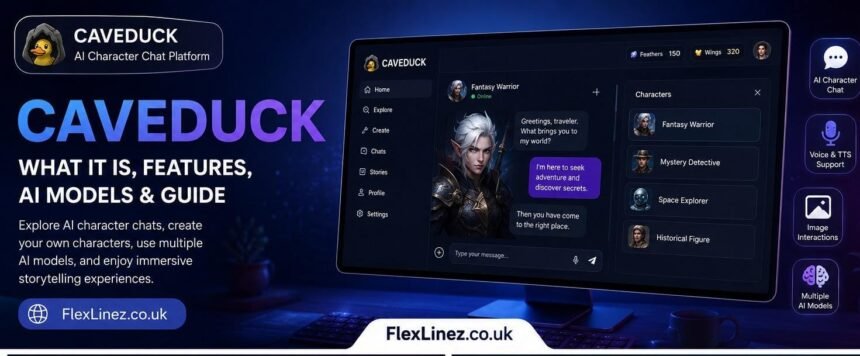
If you have searched for Caveduck, you may be wondering whether it is simply another AI chatbot or something more specialized. Caveduck is an AI character-chat platform built around conversations with customizable virtual characters. Instead of focusing mainly on general questions and productivity tasks, it emphasizes character-based conversations, storytelling, roleplay, and creative interaction.
- What Is Caveduck?
- How Does Caveduck Work?
- Caveduck AI Characters Explained
- Can You Create Your Own Caveduck Character?
- What Can You Do on Caveduck?
- What Are Caveduck AI Models?
- What Are Feathers and Wings?
- Is Caveduck Free?
- Is Caveduck Different From a Regular AI Chatbot?
- Caveduck for Creative Writing and Story Development
- Caveduck Memory and Personas
- What Is a Caveduck Story?
- Is Caveduck Safe to Use?
- What About Privacy?
- Common Mistakes When Using Caveduck
- Mistake 1: Giving No Context
- Mistake 2: Changing the Character’s Personality Constantly
- Mistake 3: Ignoring Character Information
- Mistake 4: Assuming Every AI Response Is Correct
- Mistake 5: Sharing Too Much Personal Information
- How to Get Better AI Character Responses
- Who Might Find Caveduck Interesting?
- Caveduck: Pros and Cons
- Conclusion: Is Caveduck Worth Understanding?
The platform allows users to discover existing AI characters and, depending on the available features, create characters with their own personalities, backgrounds, greetings, and scenarios. Caveduck also supports different AI models and multimedia features such as voice and image-related interactions.
But how does Caveduck actually work? What makes it different from a traditional AI assistant? Can users create their own characters? What are its costs and limitations? And what should people know about privacy and age restrictions?
This guide answers those questions in straightforward language.
What Is Caveduck?
Caveduck is a platform designed for chatting with AI characters. According to its official documentation, users can interact with characters through conversations and can also create their own characters. The service supports different AI models and offers interactions beyond ordinary text chat, including voice, images, and certain video formats.
The main idea is simple: instead of asking an AI assistant to answer a general question, you interact with an AI character that has predefined characteristics.
For example, a character might be designed as:
- A fantasy adventurer
- A fictional detective
- A storytelling companion
- An original science-fiction character
- A game-style character
- A fictional historical personality
The character’s instructions influence how it responds, which can make conversations feel more consistent and story-focused than ordinary chatbot conversations.
How Does Caveduck Work?
The basic experience revolves around choosing a character and starting a conversation.
Caveduck provides tools for discovering characters through areas such as featured, recent, trending, popular, and tagged characters. Users can also search for a particular character.
A typical workflow looks like this:
- Browse available characters.
- Select a character that interests you.
- Read the character’s description and settings.
- Start a new conversation.
- Adjust your user information or persona when appropriate.
- Continue the conversation and guide the story.
The result is closer to interactive fiction than a conventional search engine.
Caveduck AI Characters Explained
AI characters are at the center of the platform.
A character is not simply a name attached to a chatbot. Creators can define characteristics that influence how the character behaves and communicates.
Depending on the creation tools available, a character can include information such as:
| Character Element | Purpose |
|---|---|
| Name | Identifies the character |
| Personality | Defines typical behavior and tone |
| Background | Provides context and history |
| Greeting | Creates the opening interaction |
| Scenario | Establishes the situation |
| Tags | Helps users discover the character |
| Example dialogue | Demonstrates expected responses |
| Persona information | Gives the AI context about the user |
This structure is useful for storytelling because the AI has more context than it would have from a single ordinary prompt.
Can You Create Your Own Caveduck Character?
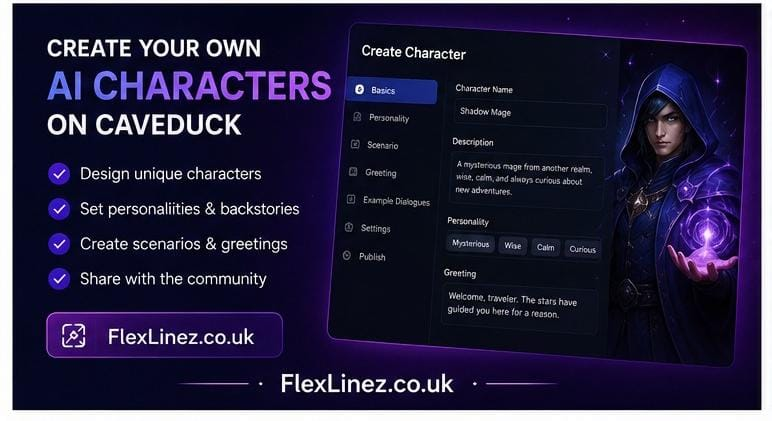
Yes. Caveduck provides character-creation tools that allow creators to develop original characters and publish them for others to use. Its documentation also describes advanced creation features and creator-oriented options.
A good character starts with a clear concept.
For example, instead of creating a character with a vague instruction such as:
“You are a funny person.”
A more useful concept might be:
“You are a fictional museum detective who solves unusual historical mysteries. You speak clearly, notice small details, and explain your reasoning through dialogue.”
The second description gives the AI a much clearer behavioral direction.
Tips for Creating a Better Character
If you’re creating an original character, focus on consistency rather than simply adding lots of information.
Consider these elements:
- Give the character a distinct personality.
- Establish a clear background.
- Explain the setting.
- Write an appropriate opening greeting.
- Define the character’s communication style.
- Avoid contradictory instructions.
- Use relevant tags so people can understand the character’s theme.
Caveduck’s official creation documentation notes that characters can be private, accessible through a link, or public. Public characters may also participate in the platform’s creator incentive system.
What Can You Do on Caveduck?
Caveduck is primarily designed around character interaction, but its feature set extends beyond basic text messages.
Character Chat
The core feature is conversation with AI characters.
Rather than starting with a blank chatbot, you enter a conversation where the character already has a defined identity and scenario.
Storytelling
Character-based AI can be useful for interactive storytelling because the user can influence what happens next.
For example:
You enter an abandoned library and discover a locked room.
Instead of reading a fixed story, the conversation can allow the user to decide what happens next.
Voice Features
Caveduck documentation states that the platform supports voice interactions through text-to-speech.
This can make a character conversation feel more dynamic than text alone.
Image-Based Features
The platform also supports image-related interactions, allowing visual elements to become part of the experience.
Availability and limitations can depend on the particular model or feature being used.
What Are Caveduck AI Models?
One important part of Caveduck is its support for multiple AI models.
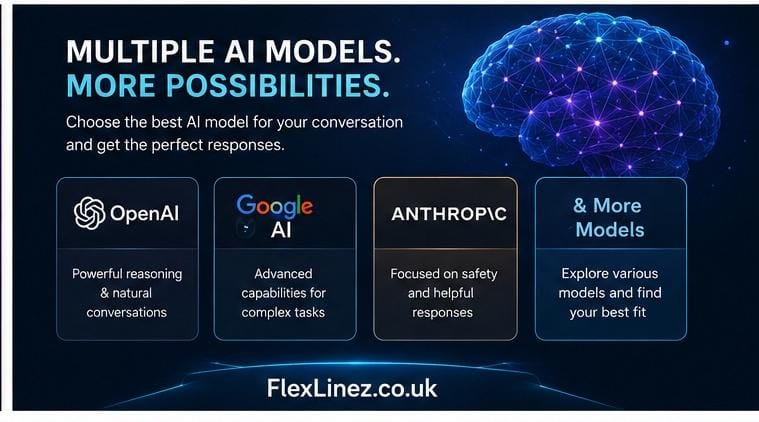
Rather than relying on a single model for every conversation, the platform provides different model choices. Its current documentation lists models from providers including Google, Anthropic, and OpenAI, alongside other models available through the service.
This matters because different models can behave differently.
For example:
- One model may be better at creative storytelling.
- Another may provide stronger reasoning.
- Another may respond more quickly.
- Some may require more platform credits than others.
Caveduck’s documentation distinguishes between standard and premium models, with some premium options requiring Wings.
What Are Feathers and Wings?
Caveduck uses platform-specific credits for some interactions.
The official documentation describes Feathers and Wings as part of its usage system. Daily Feathers can be used for certain conversations, while Wings are associated with premium model usage and other paid functionality.
This means that users should check the current pricing and usage information before assuming every AI model or feature is unlimited.
A simple way to understand the system is:
| Term | General Purpose |
| Feathers | Free or daily-use credits |
| Wings | Paid credits used for certain premium features/models |
| Premium models | Higher-cost model options |
| Standard models | More economical options |
Because platform pricing can change, the current Caveduck account or official documentation should be treated as the most reliable source for current costs.
Is Caveduck Free?
Caveduck offers free access to parts of its service, although some models and features may require credits or paid access. Its documentation confirms that users receive daily Feathers for certain conversations and that premium models can require Wings.
This creates a free-to-start model rather than making every feature automatically free.
Before spending money, it is sensible to check:
- Which models are available without payment.
- How many free credits are provided.
- How quickly credits are consumed.
- Which multimedia features cost additional credits.
- Whether a subscription provides better value for your intended use.
Is Caveduck Different From a Regular AI Chatbot?
Yes. The biggest difference is the purpose of the interaction.
A general AI assistant is typically designed to answer questions, explain concepts, generate text, help with research, or perform practical tasks.
Caveduck focuses more heavily on AI characters and interactive conversations.
| Traditional AI Assistant | Caveduck |
| General questions | Character-based conversations |
| Productivity | Interactive storytelling |
| Research and explanations | Character scenarios |
| Writing assistance | Roleplay-style interaction |
| One general assistant | Many character configurations |
There can be overlap between the two, but the user experience is different.
Caveduck for Creative Writing and Story Development
One interesting application of character AI is brainstorming.
A writer could create a fictional character and use conversation to explore:
- Character motivations
- Dialogue ideas
- Fictional conflicts
- Story scenarios
- Personality traits
- World-building concepts
However, AI-generated ideas should be treated as brainstorming material rather than automatically correct or publication-ready writing.
A human writer still needs to review the material for originality, consistency, accuracy, and quality.
Caveduck Memory and Personas
Long conversations can become difficult for any AI system to maintain perfectly. Caveduck therefore includes memory-related functionality designed to preserve important information across conversations.
Its documentation describes automatic chat summaries and persona-related functionality.
A persona can provide information about the user that the character should know during a conversation.
For example, a fictional character might be told that the user is:
- A detective
- A student in a fictional world
- A spaceship pilot
- A fantasy traveler
The key benefit is consistency.
Instead of repeating the same context in every message, relevant information can be incorporated into the character experience.
What Is a Caveduck Story?
Caveduck also provides a Story feature for characters.
According to its documentation, stories can provide additional background and narrative material that cannot always be represented through ordinary character settings. Creators can publish episodes or behind-the-scenes material connected to their characters.
An important distinction is that a Story is a narrative layer; it does not automatically change the character’s underlying chat settings.
This makes the feature useful for creators who want to expand a character’s world without rewriting its entire configuration.
Is Caveduck Safe to Use?
Safety depends partly on how the platform is used and what information a person shares.
Caveduck’s Terms of Service prohibit various forms of harmful or unlawful content and place responsibilities on users regarding content they submit.
The platform also has specific rules around characters, images, intellectual property, and adult-oriented material. Its character guidelines prohibit sexual content involving minors and impose additional restrictions on characters that could be perceived as minors.
For younger users especially, it is important to follow the platform’s age requirements and avoid adult-oriented areas or conversations.
Caveduck’s Terms state that children under 13 cannot register, with additional restrictions for users under 16 in the European Economic Area.
What About Privacy?
Privacy is another factor worth considering with any AI chat platform.
Caveduck has a published privacy policy explaining how information associated with its services is handled.
As a general rule, avoid putting sensitive personal information into AI conversations unless you clearly understand how that information is handled.
For example, don’t casually share:
- Passwords
- Banking information
- Private identification numbers
- Precise home-address information
- Private information about another person
An AI character may feel conversational, but it is still software running on a digital service.
Common Mistakes When Using Caveduck
Getting better results often depends on how clearly you communicate with the character.
Mistake 1: Giving No Context
A character cannot reliably follow a story that has no clear setting.
Less useful:
“Let’s start.”
Better:
“We are beginning a mystery story in a small coastal town. You are the detective investigating a missing journal.”
The second version establishes context immediately.
Mistake 2: Changing the Character’s Personality Constantly
If you repeatedly give contradictory instructions, responses can become inconsistent.
Try to maintain a stable character concept.
Mistake 3: Ignoring Character Information
Creators often provide useful details in a character’s profile. Caveduck’s chat documentation specifically recommends checking the character information and any tips provided by its creator.
Mistake 4: Assuming Every AI Response Is Correct
AI characters can generate inaccurate information or inconsistent details.
If a conversation includes factual claims about history, science, law, medicine, or another important subject, verify those claims independently.
Mistake 5: Sharing Too Much Personal Information
Keep conversations appropriately private and avoid unnecessary sensitive information.
How to Get Better AI Character Responses
You don’t need complicated prompts to improve a character conversation.
Try these practical techniques.
Be Specific
Instead of:
“Make this interesting.”
Try:
“Continue the mystery, but reveal one small clue without solving the case.”
Define the Tone
You can specify whether you want the conversation to feel:
- Serious
- Humorous
- Mysterious
- Educational
- Adventurous
- Calm
Give the AI a Clear Objective
For example:
“Help me explore this fictional world while keeping the character’s personality consistent.”
Clear objectives generally provide more useful direction than vague requests.
Who Might Find Caveduck Interesting?
Caveduck may appeal to people interested in:
- AI character technology
- Interactive fiction
- Creative storytelling
- Character design
- World-building
- AI-assisted brainstorming
- Experimental chatbot experiences
It is less relevant if your main goal is traditional productivity, such as spreadsheet analysis, professional research, or office automation.
Caveduck: Pros and Cons
Before trying any AI character platform, it helps to look at both sides.
Potential Advantages
- Character-focused conversations
- User-created characters
- Multiple AI model options
- Storytelling possibilities
- Persona and memory features
- Voice-related functionality
- Image-related functionality
- Character discovery and tagging
These features are documented by Caveduck and its official help materials.
Potential Limitations
- Some advanced models require paid credits.
- AI responses can still be inconsistent.
- Character quality varies by creator.
- Platform features can change over time.
- Users need to understand the service’s privacy and content rules.
- Age restrictions and content-access rules apply.
The quality of an experience can therefore depend heavily on the character, model, prompt, and settings you choose.
Frequently Asked Questions About Caveduck
What is Caveduck?
Caveduck is an AI character-chat platform where users can interact with AI characters and create characters of their own. It supports different AI models and multimedia features such as voice and image-based interactions.
Is Caveduck an AI chatbot?
Yes, but it is more specialized than a general-purpose chatbot. Its primary focus is character-based conversations, storytelling, and interactive experiences.
Can you create characters on Caveduck?
Yes. Caveduck provides character-creation tools that allow creators to define character information, settings, and other details before making a character available privately or publicly.
Does Caveduck use multiple AI models?
Yes. Caveduck provides access to multiple AI models, including both standard and premium options.
Is Caveduck free?
Caveduck offers free functionality, including access to daily Feathers for certain conversations. Some premium models and features require Wings or other paid access.
Does Caveduck support voice?
Yes. The platform’s documentation states that users can communicate with characters through voice/text-to-speech functionality.
Can Caveduck characters remember previous conversations?
Caveduck provides memory-related features, including automatic chat summaries designed to help preserve relevant context in longer conversations.
Are there age restrictions on Caveduck?
Yes. Caveduck’s Terms of Service restrict registration for users under 13 and impose additional restrictions for users under 16 in the European Economic Area. The platform also has separate rules for age-restricted characters and adult-oriented content.
Conclusion: Is Caveduck Worth Understanding?
Caveduck is more than a standard question-and-answer chatbot. Its main purpose is to create an environment where users can interact with AI characters, explore fictional scenarios, develop original characters, and experiment with interactive storytelling.
Its combination of character creation, multiple AI models, memory features, voice capabilities, and multimedia tools gives it a distinctive position within the broader AI-chat landscape.
The most important takeaway is to approach it as a character-focused AI platform, not simply another general-purpose assistant. Choose characters carefully, provide clear context, verify important factual information, protect your personal data, and follow the platform’s age and content rules.