


Introduction
When people search for “fintechzoom.io nasdaq,” they are usually looking for a straightforward way to understand Nasdaq-related market information, stock trends, index movements, and financial analysis available through FintechZoom.io. FintechZoom presents itself as a financial information platform covering markets, stocks, crypto, and major indexes, with a dedicated section for Nasdaq-related coverage.
- Introduction
- What Does FintechZoom.io Nasdaq Mean?
- What Is Nasdaq?
- What Is the Nasdaq Composite?
- What Is the Nasdaq-100?
- How FintechZoom.io Covers Nasdaq
- Is FintechZoom.io the Official Nasdaq Website?
- How to Read Nasdaq Information on FintechZoom
- Step 1: Identify the Index
- Step 2: Check the Date
- Step 3: Check the Original Source
- Step 4: Understand What the Number Represents
- Common Mistakes When Searching for FintechZoom.io Nasdaq
- Mistake 1: Treating FintechZoom as Nasdaq
- Mistake 2: Confusing Nasdaq-100 With Nasdaq Composite
- Mistake 3: Assuming Every Nasdaq Stock Is a Technology Company
- Mistake 4: Ignoring the Date
- Mistake 5: Treating Market Commentary as a Guaranteed Forecast
- FintechZoom.io Nasdaq vs. Official Nasdaq Data
- Why Nasdaq Data Needs Context
- Why Investors Follow Nasdaq Indexes
- How to Research a Nasdaq Company Properly
- Start With the Company’s Business
- Examine Financial Information
- Consider the Broader Market
- Compare Multiple Sources
- A Simple Example of Reading Nasdaq Coverage
- Why the Primary Keyword Can Be Confusing
- Is FintechZoom.io Useful for Nasdaq Research?
- Practical Tips for Better Nasdaq Research
- Use Primary Sources for Important Numbers
- Read Beyond the Headline
- Distinguish Facts From Predictions
- Check the Time Frame
- Don’t Confuse an Index With an Investment
- Frequently Asked Questions
- Conclusion
The important point is that FintechZoom.io and Nasdaq are not the same thing. Nasdaq is a major financial-market company and operator of securities markets, while FintechZoom.io is a separate website that publishes financial information and analysis.
Understanding that distinction helps readers interpret market data more accurately and avoid confusing an independent financial-information website with the official source of Nasdaq index data.
This guide explains what the fintechzoom.io Nasdaq search term refers to, what Nasdaq indexes actually measure, how to interpret Nasdaq information, and which sources should be checked when accuracy matters.
What Does FintechZoom.io Nasdaq Mean?
The phrase fintechzoom.io Nasdaq is best understood as a search query connecting FintechZoom.io’s Nasdaq coverage with the broader Nasdaq market.
FintechZoom.io has a dedicated Nasdaq section that discusses technology companies, stock-market trends, earnings reports, and industry developments.
However, Nasdaq itself provides official index information, methodologies, market data, and information about listed securities. Its Global Index Watch service provides access to index values, components, weightings, and historical information.
That creates a useful distinction:
| Term | Meaning |
|---|---|
| FintechZoom.io | Financial information and analysis website |
| Nasdaq | Financial-market company and securities-market operator |
| Nasdaq Composite | Broad index tracking common-type stocks listed on Nasdaq |
| Nasdaq-100 | Index tracking 100 large non-financial Nasdaq-listed companies |
| NDAQ | Stock symbol for Nasdaq, Inc. |
Keeping these terms separate makes financial research much easier.
What Is Nasdaq?
Nasdaq is a major financial-market technology and infrastructure company. It provides market platforms, capital-market technology, data, and other financial services.
The Nasdaq Stock Market is also a major U.S. securities exchange. It is particularly associated with technology, growth, and innovative companies, although the exchange includes businesses from many different industries.
Nasdaq should therefore not be treated as simply another word for “technology stocks.”
Nasdaq as a Stock Market
A stock exchange provides a marketplace where securities can be listed and traded.
Companies can choose to list their shares on an exchange if they meet applicable requirements. Investors can then trade those securities through regulated market infrastructure and brokerage services.
Nasdaq as a Company
There is another important distinction: Nasdaq, Inc. is itself a publicly traded company.
Its ticker symbol is NDAQ, and Nasdaq’s investor-relations materials confirm that Nasdaq, Inc. trades on the Nasdaq Global Select Market under that symbol.
So, “Nasdaq” can refer to the exchange, the broader market organization, an index family, or the publicly traded company depending on context.
What Is the Nasdaq Composite?
The Nasdaq Composite Index is one of the most widely followed Nasdaq indexes.
According to Nasdaq, the Composite measures domestic and international common-type stocks listed on the Nasdaq Stock Market. Nasdaq’s current index information shows that the index contains thousands of components, making it much broader than the Nasdaq-100.
This is important because some people casually use “Nasdaq” when they actually mean the Nasdaq Composite.
Why the Nasdaq Composite Matters
The Composite can provide a broad view of the performance of companies listed on Nasdaq.
Because the index contains many securities, movements in individual companies do not necessarily tell the whole story.
For example:
- One technology company can fall while the Composite rises.
- Several large companies can rise while smaller stocks decline.
- Market-wide economic news can affect many components simultaneously.
- Sector-specific developments can influence particular groups of companies.
Therefore, looking at an index can provide context that a single-stock chart cannot.
What Is the Nasdaq-100?
The Nasdaq-100 is different from the Nasdaq Composite.
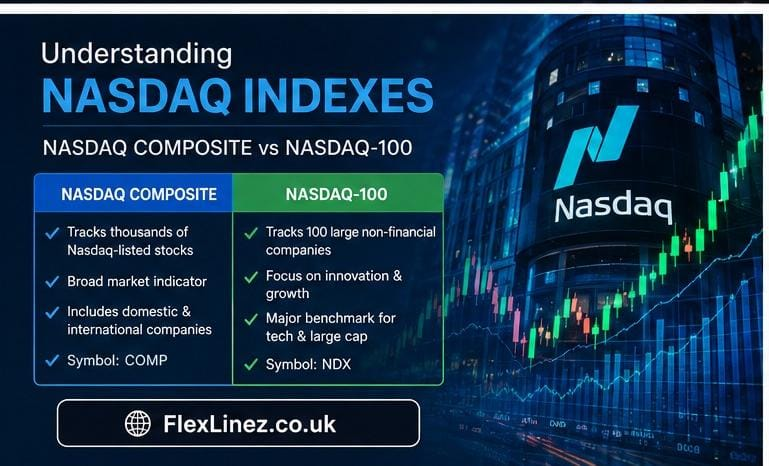
The Nasdaq-100 tracks 100 of the largest non-financial companies listed on the Nasdaq Stock Market. Nasdaq describes it as a major benchmark for technology and U.S. large-cap growth, although its components span several sectors.
Its ticker symbol is NDX.
Nasdaq-100 vs. Nasdaq Composite
The difference can be summarized simply:
| Feature | Nasdaq Composite | Nasdaq-100 |
| Coverage | Broad Nasdaq-listed common stocks | 100 large non-financial Nasdaq-listed companies |
| Number of components | Thousands | 100 |
| Breadth | Broad | More concentrated |
| Common use | Broad Nasdaq market indicator | Large-cap growth and innovation benchmark |
| Symbol | COMP | NDX |
This distinction is especially useful when reading financial articles.
A statement such as “the Nasdaq gained today” may require clarification because the writer could be referring to the Composite, Nasdaq-100, or even Nasdaq-listed stocks generally.
How FintechZoom.io Covers Nasdaq
FintechZoom.io describes its Nasdaq coverage as focusing on market movements, technology companies, stock trends, earnings reports, and industry analysis.
Its dedicated Nasdaq article also discusses Nasdaq indexes and the relationship between Nasdaq market data and financial analysis.
For readers, this type of coverage can be useful for understanding market themes.
However, secondary financial coverage should be treated differently from official exchange or index data.
What FintechZoom Can Help You Understand
A financial-information site may help readers explore:
- Market trends
- Company developments
- Earnings-related news
- Sector performance
- Historical market context
- Explanations of financial terminology
- Broader market themes
The value is often in the context and explanation, rather than treating every number as an official market quote.
Is FintechZoom.io the Official Nasdaq Website?
No.
FintechZoom.io is separate from Nasdaq.
The official Nasdaq website provides Nasdaq’s own market, index, company, and institutional information. Nasdaq’s Global Index Watch is specifically designed to provide index weights, components, and related data.
This distinction matters whenever you need to verify:
- An index value
- Official index components
- Index methodology
- Historical index information
- Corporate actions affecting an index
- Official Nasdaq company information
For those purposes, Nasdaq’s own resources are the more appropriate primary reference.
How to Read Nasdaq Information on FintechZoom
If you encounter a Nasdaq article on FintechZoom.io, don’t focus only on the headline.
Instead, examine the information systematically.
Step 1: Identify the Index
First determine whether the article is discussing:
- Nasdaq Composite
- Nasdaq-100
- Another Nasdaq index
- Nasdaq-listed stocks
- Nasdaq, Inc. (NDAQ)
This prevents one of the most common sources of confusion.
Step 2: Check the Date
Financial information changes quickly.
An article published months ago may contain useful historical analysis but should not automatically be treated as a source for today’s market conditions.
Always check:
- Publication date
- Update date
- Trading session referenced
- Whether the quoted figures are current
Step 3: Check the Original Source
If an article references Nasdaq data, earnings, economic statistics, or company announcements, look for the underlying source.
For official index information, Nasdaq provides index data services and historical information.
Step 4: Understand What the Number Represents
A market figure without context can be misleading.
For example, a percentage change might represent:
- Daily performance
- Weekly performance
- Monthly performance
- Year-to-date performance
- A comparison with the previous close
Always identify the measurement period.
Common Mistakes When Searching for FintechZoom.io Nasdaq
Mistake 1: Treating FintechZoom as Nasdaq
FintechZoom.io provides financial information, but it is not Nasdaq.
Better approach: Use FintechZoom for additional analysis and Nasdaq’s official resources for primary Nasdaq information.
Mistake 2: Confusing Nasdaq-100 With Nasdaq Composite
These indexes have different compositions and purposes.
Better approach: Check whether the article specifically names NDX or COMP.
Mistake 3: Assuming Every Nasdaq Stock Is a Technology Company
Technology is strongly represented on Nasdaq, but Nasdaq-listed companies are not limited to technology.
Better approach: Look at the company’s actual sector and business model.
Mistake 4: Ignoring the Date
A market article can become outdated quickly.
Better approach: Check when the information was published and whether it has been updated.
Mistake 5: Treating Market Commentary as a Guaranteed Forecast
Financial analysis can discuss possible scenarios, but market outcomes are uncertain.
Better approach: Separate factual market information from interpretation, forecasts, and opinions.
FintechZoom.io Nasdaq vs. Official Nasdaq Data
The two sources can serve different purposes.
| Need | Useful Source |
| General market explanation | FintechZoom.io |
| Market commentary | FintechZoom.io |
| Nasdaq index methodology | Official Nasdaq |
| Official index information | Official Nasdaq |
| Index components | Official Nasdaq |
| Nasdaq company information | Nasdaq investor relations |
| Broader financial context | FintechZoom.io and other reputable sources |
This doesn’t mean one source is automatically “better” for every purpose.
It means the source should match the question being asked.
Why Nasdaq Data Needs Context
A market index is not simply a list of companies moving in the same direction.
Indexes use specific methodologies to determine their values.
For example, Nasdaq’s index documentation explains that index calculations can involve factors such as security prices, index shares, market values, and divisors.
This means an index’s percentage movement cannot always be explained by looking at the share price of one company.
Market Capitalization Matters
Market capitalization is broadly calculated as:
Share price × shares outstanding
When an index uses market-capitalization-based weighting, larger companies can have a greater influence on the index than smaller companies.
The exact methodology varies by index, which is why readers should always check the methodology when precision matters.
Why Investors Follow Nasdaq Indexes
People follow Nasdaq indexes for several reasons.
Market Benchmarking
An index can provide a reference point for evaluating market performance.
Sector Exposure
Some Nasdaq indexes have significant exposure to technology and other growth-oriented industries.
Economic Signals
Large market movements can sometimes reflect changing expectations about:
- Interest rates
- Inflation
- Economic growth
- Corporate earnings
- Consumer demand
- Technology investment
- Global events
However, an index movement alone does not identify the exact cause. Investors and analysts generally need additional evidence.
How to Research a Nasdaq Company Properly
If a FintechZoom article makes you interested in a Nasdaq-listed company, use a structured research process.
Start With the Company’s Business
Ask:
- What does the company sell?
- Who are its customers?
- How does it make money?
- What markets does it serve?
Examine Financial Information
Look at relevant information such as:
- Revenue
- Earnings
- Cash flow
- Debt
- Profit margins
- Guidance
- Recent filings
Consider the Broader Market
A company’s share price can be influenced by factors beyond its own business.
For example, changing interest-rate expectations can affect valuations across growth-oriented stocks.
Compare Multiple Sources
A stronger research process combines company disclosures, official market information, reputable financial reporting, and analytical commentary.
No single article should be treated as the complete picture.
A Simple Example of Reading Nasdaq Coverage
Imagine an article says that “Nasdaq stocks climbed sharply.”
That sentence alone is incomplete.
A careful reader would ask:
- Which Nasdaq index is being discussed?
- What period does “climbed” refer to?
- Which sectors contributed most?
- Were large companies responsible for much of the movement?
- Was there a specific economic or company-related catalyst?
- Is the article reporting an actual market figure or providing commentary?
These questions turn a vague headline into useful financial information.
Why the Primary Keyword Can Be Confusing
The search phrase fintechzoom.io nasdaq combines a website name with a financial-market term.
That can create several possible search intentions.
| Search Intent | What the Searcher May Want |
| Navigational | Find FintechZoom’s Nasdaq coverage |
| Informational | Understand Nasdaq through FintechZoom |
| Data-focused | Find current Nasdaq information |
| Comparative | Compare FintechZoom information with official Nasdaq data |
| Educational | Learn about Nasdaq indexes |
A useful article therefore needs to address both the website and the underlying Nasdaq concepts.
Is FintechZoom.io Useful for Nasdaq Research?
It can be useful as a secondary source for financial information and market commentary, particularly when readers want explanations, trends, or broader context.
But when a precise or official Nasdaq figure matters, readers should verify it using Nasdaq’s own resources.
Nasdaq provides official index services, including real-time and historical information for its indexes and related products.
The strongest approach is not to rely blindly on one source. Instead, use secondary analysis to understand the story and primary sources to verify important facts.
Practical Tips for Better Nasdaq Research
Use Primary Sources for Important Numbers
If a figure could materially affect your understanding of the market, verify it against an official source.
Read Beyond the Headline
Headlines simplify complex financial events.
The body of the article usually provides the context needed to understand what happened.
Distinguish Facts From Predictions
A reported earnings figure is different from an analyst’s expectation.
Similarly, a historical price movement is different from a forecast about where the market might go next.
Check the Time Frame
Always ask whether a figure represents:
- Intraday performance
- One trading day
- A month
- A quarter
- A year
Don’t Confuse an Index With an Investment
An index measures a group of securities according to a methodology. It is not automatically the same thing as an individual stock or a particular investment product.
Frequently Asked Questions
What does “fintechzoom.io Nasdaq” mean?
It generally refers to Nasdaq-related financial information and analysis published on FintechZoom.io. FintechZoom.io is separate from Nasdaq itself.
Is FintechZoom.io the official Nasdaq website?
No. FintechZoom.io is an independent financial-information website. Nasdaq operates its own official websites and data services.
What is the Nasdaq Composite?
The Nasdaq Composite is a broad index measuring domestic and international common-type stocks listed on the Nasdaq Stock Market. Nasdaq describes it as one of the major widely followed market indexes.
What is the Nasdaq-100?
The Nasdaq-100 is an index of 100 large non-financial companies listed on Nasdaq. Its index symbol is NDX.
Is Nasdaq only for technology companies?
No. Although technology companies have a strong presence on Nasdaq, companies from multiple industries are listed there.
What is NDAQ?
NDAQ is the ticker symbol for Nasdaq, Inc., the publicly traded company. Nasdaq’s investor-relations information confirms that its shares trade on the Nasdaq Global Select Market under NDAQ.
Should I use FintechZoom or Nasdaq for official index information?
For official Nasdaq index information, methodology, components, and related data, Nasdaq’s own resources are the appropriate primary reference. FintechZoom can provide additional context and commentary.
Can a Nasdaq index rise even when some Nasdaq stocks fall?
Yes. An index represents a group of securities, and its overall movement depends on the performance and weighting of its components. Individual stocks can therefore move in different directions while the overall index rises or falls.
Conclusion
The search term fintechzoom.io Nasdaq is best understood as a gateway to Nasdaq-related financial coverage on FintechZoom.io rather than as the name of an official Nasdaq product.
FintechZoom.io can help readers explore market trends, company developments, earnings information, and broader financial themes. At the same time, Nasdaq remains the primary source for official index information, methodologies, components, and market-data services.
The most useful habit is simple: use financial commentary for context, but verify important market facts with primary sources. Also make sure you know whether an article is discussing the Nasdaq Composite, Nasdaq-100, a specific Nasdaq-listed company, or Nasdaq, Inc. itself.
That distinction makes it much easier to interpret fintechzoom.io Nasdaq coverage accurately and responsibly.