



Introduction
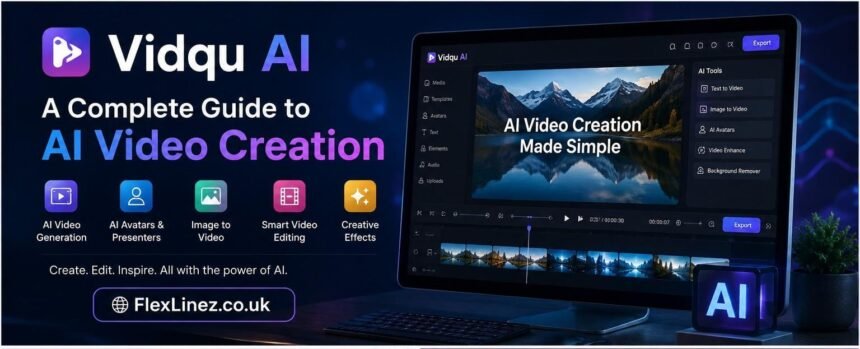
Creating engaging videos used to require a camera, editing software, good lighting, and plenty of time. Today, AI-powered video tools are changing that process by helping users create and edit visual content with fewer technical steps. Vidqu AI is one of the platforms that has attracted attention in this space.
- Introduction
- What Is Vidqu AI?
- How Does Vidqu AI Work?
- What Can You Use Vidqu AI For?
- Key Features to Look For in Vidqu AI
- Vidqu AI vs Traditional Video Editing
- How to Get Better Results With Vidqu AI
- 1. Start With a Clear Objective
- 2. Describe the Visual Style
- 3. Keep the Script Focused
- 4. Review Every Generated Result
- Common Mistakes to Avoid
- Expecting One Prompt to Produce a Perfect Video
- Giving Extremely Vague Instructions
- Ignoring Copyright and Permissions
- Publishing AI Output Without Checking It
- Is Vidqu AI Easy for Beginners?
- Is Vidqu AI Free?
- Who Can Benefit From Vidqu AI?
- What Are the Limitations of AI Video Tools?
- Vidqu AI: A Practical Workflow
- Step 1: Choose One Small Project
- Step 2: Prepare Your Script
- Step 3: Plan the Scenes
- Step 4: Generate the First Version
- Step 5: Edit and Review
- Step 6: Export and Evaluate
- Frequently Asked Questions About Vidqu AI
- Conclusion
But what exactly is Vidqu AI, and what can you realistically do with it?
In this guide, we will explore Vidqu AI, its main capabilities, potential use cases, advantages and limitations, and practical tips for getting better results. Whether you are researching AI video generators or simply trying to understand what the platform offers, this article will give you a clear starting point.
Important: AI platforms can change their features, pricing, and availability over time. Check the platform’s current information before relying on a specific feature or plan.
What Is Vidqu AI?
Vidqu AI is an AI-focused platform designed around creating and transforming visual content. Rather than requiring users to perform every editing task manually, AI-based tools can automate parts of the video-production workflow.
Depending on the tools and features available at a particular time, platforms in this category may support tasks such as:
- AI-assisted video creation
- Image-to-video generation
- Text-based content creation
- AI avatars or presenters
- Video editing and enhancement
- Creative visual effects
- Background or visual transformations
- Social-media-oriented content creation
The main attraction is convenience. Instead of learning a complicated professional video editor first, a beginner can use AI-assisted workflows to experiment with video production more quickly.
How Does Vidqu AI Work?
The basic idea behind an AI video platform is relatively simple.
You provide an input, such as text, an image, or another piece of media. The AI system then processes that input according to the selected tool and produces an output.
A simplified workflow looks like this:
Input → AI processing → Generated or transformed content → Review → Final edit
For example, imagine that you want to turn a still image into a short visual sequence. Instead of manually creating keyframes and animations, an AI tool may interpret the image and generate movement based on your instructions.
The exact workflow depends on the feature being used.
What Can You Use Vidqu AI For?
The usefulness of an AI video platform depends largely on your goal. Some users may want short-form social content, while others may simply want to experiment with creative video production.
Social Media Content
Short videos are widely used across social platforms. AI-assisted creation can help users produce concepts, visual variations, and simple video assets without starting every project from scratch.
For example, a creator could develop a short educational video around a simple topic:
- Write the main idea.
- Prepare a short script.
- Generate or assemble visual material.
- Review the result.
- Add captions or other edits.
- Export the finished video.
AI can reduce some of the repetitive work, although human review is still important.
Marketing Content
Businesses and marketers often need multiple versions of similar content.
An AI video workflow can potentially help with:
- Product introductions
- Promotional clips
- Explainer videos
- Social advertisements
- Short announcements
- Educational marketing content
The important point is not to assume that AI automatically creates effective marketing. A strong message, accurate information, good design, and an appropriate audience still matter.
Educational Videos
AI-generated visual content can also be useful for explaining relatively simple concepts.
For instance, an educational creator could start with:
“Explain how the water cycle works for a 12-year-old.”
The resulting concept could then be reviewed and adapted into a short lesson.
AI should not replace fact-checking, especially when the content involves science, history, health, finance, or other subjects where inaccurate information could cause problems.
Key Features to Look For in Vidqu AI
Because AI platforms frequently update their tools, it is better to evaluate features based on what is currently available rather than assuming every feature remains unchanged.
Here are the major categories worth examining.
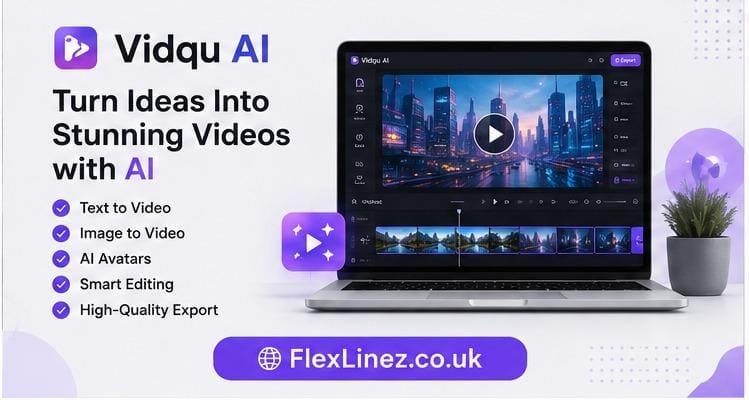
AI Video Generation
An AI video generator can help transform an idea or prompt into visual content.
The quality of generated video depends on several factors, including:
- Prompt clarity
- Input quality
- Model capabilities
- Video length
- Motion complexity
- Scene composition
A vague prompt can produce an unpredictable result, while a well-structured prompt usually gives the system more useful direction.
AI Avatars and Presenters
Some AI video platforms provide virtual presenters that can deliver prepared scripts.
This can be useful when you want a presenter-style video without recording yourself.
However, users should pay attention to consent, identity rights, and platform rules when using images or likenesses of real people.
Image-to-Video Creation
Image-to-video tools attempt to add movement to still images.
For example:
Input: A landscape photograph
Instruction: Create subtle camera movement while keeping the scene natural.
The result can be more dynamic than a completely static image.
AI-Assisted Editing
AI can also help simplify certain editing tasks.
Depending on the available tools, this may include automatically handling parts of:
- Scene creation
- Captions
- Visual adjustments
- Background changes
- Content variations
- Basic video assembly
These tools are particularly useful for beginners who do not want to spend hours learning advanced editing software.
Vidqu AI vs Traditional Video Editing
AI video creation does not necessarily replace traditional editing. The two approaches have different strengths.
| AI-Assisted Creation | Traditional Editing |
|---|---|
| Faster for some workflows | Greater manual control |
| Easier for beginners | More technical learning |
| Useful for rapid experimentation | Excellent for detailed editing |
| Can automate repetitive tasks | Precise timeline-based control |
| Results depend on AI output | Results depend mainly on editor skill |
A practical workflow may combine both.
For example, AI could help create a first draft, while a conventional editor is used to correct timing, captions, audio, transitions, and other details.
How to Get Better Results With Vidqu AI
Simply entering a few words and expecting a perfect video is usually unrealistic.
Better results often come from better instructions and careful review.
1. Start With a Clear Objective
Before opening an AI tool, decide what you want the video to accomplish.
Instead of:
“Make a video about technology.”
Try something more specific:
“Create a short educational video explaining how cloud storage works for beginners.”
The second instruction gives the system a clearer direction.
2. Describe the Visual Style
When appropriate, explain the desired visual approach.
For example:
“Use a clean educational style with simple graphics, readable text, and smooth transitions.”
This provides more useful guidance than simply saying “make it good.”
3. Keep the Script Focused
Long, complicated scripts can make short videos difficult to follow.
A useful structure is:
Hook → Main point → Explanation → Takeaway
For example:
Hook: Why does your phone seem to know what you searched for?
Main point: Many apps use data to personalize recommendations.
Explanation: Explain the basic process in simple language.
Takeaway: Review your privacy settings regularly.
4. Review Every Generated Result
AI output should be treated as a draft rather than an unquestionable final product.
Check:
- Facts
- Spelling
- Grammar
- Names
- Numbers
- Captions
- Visual consistency
- Audio quality
- Overall message
A few minutes of review can make a major difference.
Common Mistakes to Avoid
Expecting One Prompt to Produce a Perfect Video
AI generation is not always predictable.
If the first result is weak, improve the instructions rather than assuming the entire tool is useless.
Giving Extremely Vague Instructions
“Make an amazing video” does not communicate much.
Instead, describe the topic, audience, tone, visual style, duration, and key message where relevant.
Ignoring Copyright and Permissions
Do not assume that every image, voice, video clip, logo, or character can be used freely.
Before publishing content, consider whether you have the necessary rights or permission.
Publishing AI Output Without Checking It
AI can make mistakes.
A generated video may contain incorrect text, awkward visuals, misleading information, or other problems. Human review remains essential.
Is Vidqu AI Easy for Beginners?
AI-powered interfaces are generally designed to reduce technical barriers, but “easy” depends on what you are trying to create.
A beginner making a simple short video may find an AI workflow much easier than learning a professional editing application.
On the other hand, advanced projects involving detailed timing, complex sound design, precise motion graphics, or professional color correction may still require conventional editing knowledge.
The best approach is to start with a small project and learn the workflow gradually.
Is Vidqu AI Free?
Whether Vidqu AI offers a free option, trial credits, or paid plans can change over time.
If you are considering using the platform, check its current pricing information directly before making a purchasing decision.
Pay particular attention to:
- Monthly or annual pricing
- Free usage limits
- Credit systems
- Export restrictions
- Watermarks
- Commercial-use permissions
- Resolution limits
- Feature availability
A low-cost plan is not necessarily the best value if it has limitations that affect your particular workflow.
Who Can Benefit From Vidqu AI?
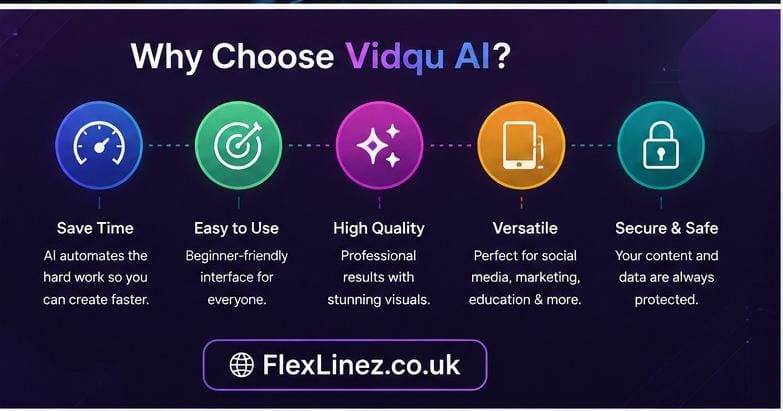
Vidqu AI may be worth exploring if you are interested in:
- AI-assisted video production
- Short-form content
- Educational videos
- Marketing content
- Creative experimentation
- Faster video workflows
- Beginner-friendly production tools
However, professional creators should evaluate output quality, control, licensing, reliability, and workflow compatibility before choosing any AI video platform as a core production tool.
What Are the Limitations of AI Video Tools?
AI video technology has improved quickly, but it is not perfect.
Potential limitations include:
- Inconsistent generated results
- Visual artifacts
- Incorrect text
- Limited creative control
- Unpredictable motion
- Credit or usage restrictions
- Changing features
- Privacy and licensing considerations
This is why AI works best as a creative assistant rather than something that should automatically make every production decision.
Vidqu AI: A Practical Workflow
If you want to experiment with an AI video platform, try this simple workflow.
Step 1: Choose One Small Project
Do not begin with a complicated 10-minute production.
Start with a short video that has one clear purpose.
Step 2: Prepare Your Script
Write the message before worrying about visual effects.
Keep sentences natural and easy to understand.
Step 3: Plan the Scenes
Break the script into visual sections.
For example:
| Scene | Purpose |
| 1 | Introduce the topic |
| 2 | Explain the main idea |
| 3 | Show an example |
| 4 | Summarize the lesson |
Step 4: Generate the First Version
Use your chosen AI features to create an initial version.
Do not spend too much time trying to make the first attempt perfect.
Step 5: Edit and Review
Correct anything that looks or sounds wrong.
Pay special attention to text appearing on screen because AI-generated text can sometimes require correction.
Step 6: Export and Evaluate
Watch the entire video from beginning to end.
Ask yourself:
- Is the message clear?
- Is the pacing comfortable?
- Are the visuals relevant?
- Can viewers understand it without extra explanation?
If the answer is yes, the video is ready for the next stage.
Frequently Asked Questions About Vidqu AI
What is Vidqu AI?
Vidqu AI is an AI-oriented platform for creating or transforming digital visual content. Its available tools and features may change as the service develops.
Can beginners use Vidqu AI?
Yes, AI-assisted video workflows can be suitable for beginners because they can reduce some of the technical work involved in creating visual content. However, beginners should still review generated results carefully.
What can Vidqu AI create?
Depending on the currently available tools, Vidqu AI may support different types of AI-powered video and visual-content workflows. Check the platform’s current feature list for the latest capabilities.
Is Vidqu AI completely free?
Pricing and free usage can change. Some AI platforms use free limits, credits, trials, or subscription plans. Always check the current terms before relying on a particular pricing option.
Is AI-generated video ready to publish immediately?
Not necessarily. Generated content should be checked for accuracy, grammar, visual quality, permissions, and consistency before publication.
Can Vidqu AI replace professional video editors?
For simple projects, AI can automate parts of the production process. It does not necessarily replace the creative judgment and detailed control provided by an experienced video editor.
What makes a good AI video prompt?
A useful prompt usually explains the subject, purpose, audience, visual direction, and other important constraints. Specific instructions are generally more helpful than vague descriptions.
Should you use Vidqu AI for content creation?
It can be worth exploring if its current features match your needs. The best choice depends on your required video quality, editing control, budget, usage rights, and preferred workflow.
Conclusion
Vidqu AI represents the broader shift toward AI-assisted video creation, where technology can handle parts of the process that traditionally required more manual work. It can be useful for beginners, creators, educators, marketers, and anyone interested in experimenting with faster visual-content workflows.
The key is to use AI intelligently. Start with a clear objective, provide specific instructions, review every result, and make final creative decisions yourself.
If you are considering Vidqu AI, do not judge it only by how impressive a single generated clip looks. Evaluate whether its current features, quality, pricing, controls, and usage terms actually fit the type of videos you want to create.
Practical takeaway
Use Vidqu AI as a production assistant, not as a substitute for human judgment. The strongest results usually come from combining AI’s speed with careful planning, editing, fact-checking, and creative direction.