




If you are searching for FictionLab AI, you are probably interested in how artificial intelligence can help turn a simple idea into a complete story. Whether you are developing characters, planning a plot, experimenting with dialogue, or looking for help overcoming writer’s block, AI-powered fiction tools can make parts of the creative process easier.
- What Is FictionLab AI?
- Why Are Writers Interested in AI Fiction Tools?
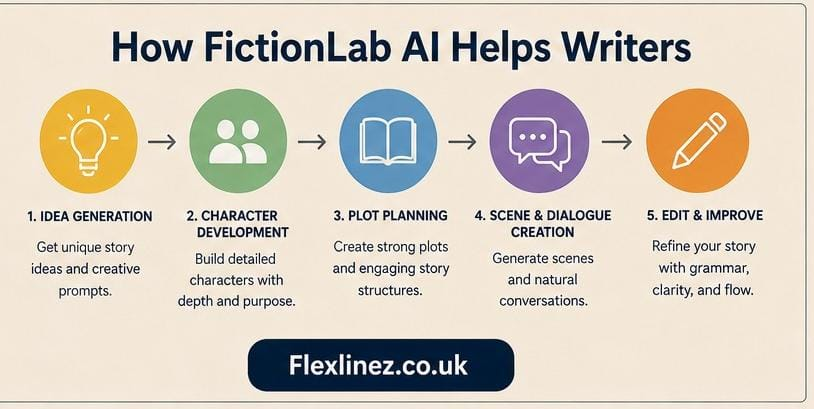
- How FictionLab AI Can Fit Into the Writing Process
- Building Better Characters With AI
- Using AI for Plot Development
- FictionLab AI and Story Structure
- AI for Scene Creation
- AI-Generated Dialogue: What Writers Should Watch For
- FictionLab AI and Worldbuilding
- Can AI Help With Grammar and Fiction Editing?
- Common Grammar Problems in Fiction
- How to Use FictionLab AI Without Losing Your Voice
- What AI Fiction Tools Are Good At
- What AI Fiction Tools Cannot Automatically Solve
- Common Mistakes When Using FictionLab AI
- Mistake 1: Asking AI to Write Everything
- Mistake 2: Giving Extremely Vague Prompts
- Mistake 3: Accepting the First Idea
- Mistake 4: Ignoring Continuity
- Mistake 5: Over-Editing the Prose
- How to Write Better Prompts for AI Fiction
- AI Fiction Writing and Originality
- Is FictionLab AI Suitable for Beginners?
- Is FictionLab AI Useful for Experienced Writers?
- A Practical AI-Assisted Fiction Workflow
- Step 1: Define the Premise
- Step 2: Establish the Protagonist
- Step 3: Create the Main Conflict
- Step 4: Build the Story Structure
- Step 5: Plan Important Scenes
- Step 6: Draft in Your Own Voice
- Step 7: Review the Draft
- Step 8: Revise
- Frequently Asked Questions About FictionLab AI
- Conclusion
But there is an important distinction to understand: an AI writing tool can generate text, yet good fiction still depends on human judgment. A compelling story needs believable characters, purposeful conflict, consistent point of view, natural dialogue, and a distinctive voice.
This guide explains what FictionLab AI refers to, what people typically want from an AI fiction-writing platform, how these tools can fit into a writing workflow, and what to watch for when using AI to develop stories.
What Is FictionLab AI?
FictionLab AI can be understood in the context of AI-assisted fiction creation: using artificial intelligence to help writers develop fictional stories, characters, scenes, and narrative ideas.
The appeal is straightforward. Traditional writing can begin with a blank page and a vague idea such as:
“I want to write a mystery about a teenager who discovers a hidden room.”
Turning that idea into a structured story, however, requires many decisions.
Who is the protagonist?
What do they want?
Why can’t they get it?
What is hidden in the room?
Who knows about it?
What happens if the secret is discovered?
An AI fiction-writing platform can help writers explore those possibilities more quickly.
Is FictionLab AI a Writing Tool or a Storytelling Concept?
The exact features associated with a platform or service called FictionLab AI may change over time. Therefore, readers should distinguish between the specific product’s current features and the broader concept of AI-assisted fiction writing.
AI storytelling tools commonly focus on areas such as:
- Story brainstorming
- Character development
- Plot planning
- Scene generation
- Dialogue assistance
- Creative prompts
- Rewriting and editing
- Worldbuilding
- Narrative experimentation
The most useful approach is to treat AI as a creative assistant, rather than as a replacement for the writer.
Why Are Writers Interested in AI Fiction Tools?
Writing fiction involves both creativity and problem-solving.
A writer may know how a story should end but have no idea how to connect the opening with that ending. Another writer may have ten character ideas but no central conflict. Someone else may simply struggle to begin.
AI tools can help generate alternatives when the creative process becomes stuck.
For example, suppose your basic concept is:
A student finds an old camera that seems to photograph events before they happen.
Instead of immediately asking an AI system to write the entire novel, you could ask it to explore:
- Three possible protagonists.
- Five sources of conflict.
- Different explanations for the camera.
- Possible weaknesses or limitations.
- Several endings with different emotional effects.
This produces a creative playground rather than a finished story.
How FictionLab AI Can Fit Into the Writing Process
A useful fiction-writing workflow can be divided into several stages.
1. Start With a Story Premise
A premise is the basic idea behind your story.
For example:
A young archivist discovers that certain historical documents change every night.
That’s interesting, but it is not yet a complete plot.
You can develop it by asking questions:
- Why do the documents change?
- Who created them?
- What happens when the protagonist notices?
- Why does the discovery matter?
- What does the protagonist risk by investigating?
These questions transform an idea into a narrative problem.
2. Develop the Main Character
Strong fiction usually needs characters with understandable motivations.
Instead of creating a character who is simply “brave,” give that bravery a reason.
For example:
Weak character concept:
A detective who is intelligent and fearless.
Stronger concept:
A detective who appears confident but avoids emotional relationships because a previous investigation caused someone close to her to leave town.
The second version creates possibilities for conflict.
AI can help you brainstorm:
- Character goals
- Fears
- Contradictions
- Personal history
- Relationships
- Strengths
- Weaknesses
- Internal conflicts
The writer still needs to decide which details actually belong in the story.
Building Better Characters With AI
One common mistake is creating characters from lists of traits.
A character does not become memorable simply because they have:
- blue eyes,
- a sarcastic personality,
- an unusual hobby,
- a mysterious past, and
- excellent intelligence.
Characterization becomes stronger when traits affect choices.
Consider this example:
Maya is extremely organized because uncertainty makes her uncomfortable.
Now the trait can influence the plot.
When something unexpected happens, Maya may try to control the situation. When that fails, she has to adapt.
That is characterization through behavior.
Character Questions Worth Exploring
When developing a protagonist, consider:
| Question | Why it matters |
|---|---|
| What does the character want? | Creates direction |
| What do they fear? | Creates emotional stakes |
| What do they misunderstand? | Creates room for development |
| What are they willing to sacrifice? | Reveals priorities |
| What contradiction defines them? | Makes them feel human |
| How do they change? | Creates an arc |
An AI tool can generate possibilities, but the writer should select details that support the story.
Using AI for Plot Development

Plotting is another area where AI can be useful.
Imagine your central idea is:
A librarian discovers that a missing book has been removed from every catalog in the city.
You could develop several possible plot structures.
Mystery Structure
The protagonist investigates who removed the book and why.
Fantasy Structure
The book contains information that can alter reality.
Thriller Structure
Someone is actively preventing the protagonist from finding it.
Historical Structure
The book contains evidence that could change the accepted version of an important event.
The same premise can therefore produce very different stories.
AI brainstorming is particularly useful at this stage because it can quickly produce contrasting possibilities.
FictionLab AI and Story Structure
A story needs movement.
One simple structure is:
Beginning → Complication → Escalation → Climax → Resolution
For example:
Beginning:
A student discovers an unexplained photograph.
Complication:
The photograph shows something that has not happened yet.
Escalation:
The student discovers additional photographs appearing without explanation.
Climax:
One photograph reveals a serious event involving someone close to them.
Resolution:
The protagonist must decide whether to change what the photograph predicts.
This framework is simple, but it helps prevent scenes from becoming disconnected episodes.
AI for Scene Creation
Once the larger story exists, AI can help explore individual scenes.
Suppose your protagonist needs to confront an old friend.
Rather than asking for a generic scene, provide constraints:
- Location
- Characters present
- Purpose of the scene
- Emotional tension
- Information that must be revealed
- Information that must remain hidden
- Desired tone
For example:
Write a tense conversation between two former friends meeting in an empty train station. One knows that the other has been hiding an important letter. Neither character wants to admit why they are there.
Specific instructions generally produce more useful creative material than vague requests.
Scene Goals Matter
Every scene should ideally do something.
It might:
- reveal information,
- create conflict,
- change a relationship,
- introduce a problem,
- increase tension,
- reveal character,
- or move the plot forward.
If removing a scene changes nothing, the scene may need revision.
AI-Generated Dialogue: What Writers Should Watch For
Dialogue is one of the areas where generated writing can sound unnatural.
Characters sometimes speak too clearly about information they would realistically already know.
For example:
Less natural:
“As you know, Daniel, we have been best friends since elementary school, and your brother disappeared three years ago.”
The characters would not normally explain shared knowledge in this way.
A more natural version might be:
“Three years, Daniel. You never told me what really happened to your brother.”
The second version leaves room for context while sounding more conversational.
Tips for Better Dialogue
When reviewing AI-generated dialogue, ask:
- Would a real person say this?
- Is the sentence too explanatory?
- Does each character sound different?
- Is the dialogue moving the scene forward?
- Are characters saying things they could communicate through actions instead?
Good dialogue is not simply grammatically correct. It needs rhythm, implication, personality, and purpose.
FictionLab AI and Worldbuilding
For fantasy, science fiction, historical fiction, and speculative stories, worldbuilding can become complex.
An AI assistant can help organize ideas about:
- Geography
- Cultures
- Governments
- Technology
- Magic systems
- Social structures
- Languages
- Historical events
- Economic systems
- Rules and limitations
However, consistency is critical.
Suppose your fictional world establishes that teleportation requires physical contact. Later, a character suddenly teleports across a city without explanation.
That creates a continuity problem.
Create a Story Bible
A simple story bible can contain:
| Category | Example |
|---|---|
| Main character | Maya |
| Setting | Coastal city |
| Central conflict | Missing historical records |
| Important object | Brass key |
| Major rule | The key opens only one door |
| Antagonist | Former archivist |
| Ending | Secret becomes public |
Keeping these details organized can reduce contradictions as the story grows.
Can AI Help With Grammar and Fiction Editing?
Yes, AI can be useful for identifying potential grammar and clarity problems.
But fiction editing is different from ordinary proofreading.
Consider:
“He ain’t going nowhere.”
In formal academic writing, this would generally be considered nonstandard English.
But if a character’s voice intentionally uses that dialect, changing it automatically could weaken the characterization.
This is why context matters.
Grammar Editing vs. Style Editing
Grammar editing focuses on issues such as:
- Subject-verb agreement
- Verb tense
- Pronoun consistency
- Sentence fragments
- Punctuation
- Incorrect word usage
Style editing considers:
- Voice
- Rhythm
- Tone
- Repetition
- Pacing
- Word choice
- Character voice
A good editing workflow should not automatically “correct” every unusual sentence.
Common Grammar Problems in Fiction
Subject-Verb Agreement
Incorrect:
The group of students are waiting outside.
Correct:
The group of students is waiting outside.
The subject is group, which is singular.
Verb Tense Consistency
Inconsistent:
She opened the door and walks into the room.
Consistent:
She opened the door and walked into the room.
Unless there is a deliberate stylistic reason, maintaining a consistent tense makes prose easier to follow.
Confusing Pronouns
Unclear:
When Sarah spoke to Emma, she looked nervous.
Who looked nervous—Sarah or Emma?
A clearer version is:
Sarah looked nervous when she spoke to Emma.
Small changes can eliminate ambiguity.
How to Use FictionLab AI Without Losing Your Voice
The biggest danger of AI-assisted writing is not grammar.
It is sameness.
If every sentence is generated, polished, expanded, and rewritten by an AI system, the final story may become technically smooth but emotionally generic.
Your voice comes from choices.
It appears in:
- the images you notice,
- the words you prefer,
- the rhythm of your sentences,
- the characters you create,
- the subjects you explore,
- and the way you interpret events.
AI should support those choices rather than erase them.
A Better Workflow
Try this process:
Idea → Human outline → AI brainstorming → Human selection → Draft → AI feedback → Human revision
This keeps creative control with the writer.
What AI Fiction Tools Are Good At
AI-assisted fiction tools can be particularly helpful for:
- Brainstorming story premises
- Generating alternative plot directions
- Creating character questions
- Exploring different genres
- Finding potential scene ideas
- Identifying continuity issues
- Suggesting revisions
- Overcoming blank-page anxiety
- Experimenting with dialogue
- Creating writing exercises
The key is to use them selectively.
What AI Fiction Tools Cannot Automatically Solve
AI does not automatically guarantee:
- originality,
- emotional depth,
- factual accuracy,
- consistent characterization,
- literary quality,
- or a compelling story.
A generated paragraph can be grammatically perfect and still be boring.
Likewise, a strange sentence can sometimes be exactly what a fictional character needs.
The writer remains responsible for deciding what belongs in the final work.
Common Mistakes When Using FictionLab AI
Mistake 1: Asking AI to Write Everything
A complete story generated from a short prompt may technically have a beginning, middle, and ending, but it may not reflect your intended voice.
Better approach: Break the process into smaller creative decisions.
Mistake 2: Giving Extremely Vague Prompts
“Write me a great fantasy story” provides little direction.
Instead, specify:
- genre,
- protagonist,
- setting,
- conflict,
- tone,
- audience,
- narrative perspective,
- and desired outcome.
Mistake 3: Accepting the First Idea
The first generated idea is not necessarily the best one.
Ask for alternatives and compare them.
Mistake 4: Ignoring Continuity
Long stories can develop contradictions involving characters, locations, timelines, and rules.
Maintain a story bible and check important details.
Mistake 5: Over-Editing the Prose
Not every unusual sentence needs to be polished into conventional language.
Fiction often benefits from personality.
How to Write Better Prompts for AI Fiction
A useful prompt can follow this structure:
Task + Context + Constraints + Desired Output
For example:
Develop three possible plot directions for a mystery novel about a teenager who discovers that an abandoned railway station appears on no modern map. Keep the story grounded and avoid supernatural explanations. For each option, provide the central conflict, antagonist, midpoint twist, and possible ending.
This is more useful than:
Give me a mystery story.
Prompting Questions to Try
You can ask an AI writing assistant:
- “Give me five different motivations for this character.”
- “What plot holes might exist in this outline?”
- “Suggest three ways to increase tension without adding violence.”
- “Rewrite this dialogue while preserving the character’s personality.”
- “Identify places where the protagonist’s motivation becomes unclear.”
- “Suggest ways to make this scene shorter without losing important information.”
These requests encourage collaboration instead of passive generation.
AI Fiction Writing and Originality
Originality does not necessarily mean inventing something that has never existed before.
Many stories use familiar ingredients.
What matters is how those ingredients are combined and interpreted.
A detective story can become original through:
- its setting,
- protagonist,
- moral dilemma,
- narrative structure,
- character relationships,
- or central question.
AI can help generate combinations, but the writer needs to make the final creative decisions.
Is FictionLab AI Suitable for Beginners?
AI-assisted fiction tools can be useful for beginners because they reduce the intimidation of the blank page.
A new writer can experiment with:
- story premises,
- character profiles,
- dialogue,
- scene structure,
- and basic editing.
However, beginners should also learn fundamental writing skills.
Understanding point of view, characterization, conflict, pacing, grammar, paragraph structure, and dialogue will make AI-generated suggestions much easier to evaluate.
AI becomes more useful when the writer knows what good writing looks like.
Is FictionLab AI Useful for Experienced Writers?
Experienced writers may use AI differently.
Instead of asking for complete chapters, they may use it as a development or revision assistant.
For example:
“Here is my plot outline. Identify three potential pacing problems.”
Or:
“Here is a character profile. Point out contradictions in the motivation.”
This approach can provide another perspective without handing over the creative process.
A Practical AI-Assisted Fiction Workflow
Here is a simple process you can use.
Step 1: Define the Premise
Write your story idea in one or two sentences.
Step 2: Establish the Protagonist
Define the character’s goal, fear, motivation, and central problem.
Step 3: Create the Main Conflict
Ask what prevents the protagonist from achieving the goal.
Step 4: Build the Story Structure
Identify the beginning, major turning points, climax, and ending.
Step 5: Plan Important Scenes
Give every major scene a clear purpose.
Step 6: Draft in Your Own Voice
Use AI assistance where helpful, but maintain creative control.
Step 7: Review the Draft
Look for:
- Grammar errors
- Repetition
- Weak transitions
- Plot holes
- Inconsistent character behavior
- Unnecessary exposition
- Pacing problems
Step 8: Revise
The final stage should be human judgment.
Read the story as a reader, not just as an editor.
Frequently Asked Questions About FictionLab AI
What is FictionLab AI?
FictionLab AI refers to AI-assisted fiction creation and, depending on the specific service being discussed, may involve tools for developing stories, characters, plots, scenes, or other creative writing elements.
Can FictionLab AI write an entire story?
AI systems can generate substantial amounts of fictional text, but producing a coherent and engaging complete story usually requires human planning, editing, fact-checking where relevant, and revision.
Can AI help create fictional characters?
Yes. AI can brainstorm character motivations, personalities, backgrounds, conflicts, relationships, goals, and character arcs.
Can AI improve fiction grammar?
AI can identify many common grammar, punctuation, spelling, and clarity problems. However, writers should review suggested changes because fictional dialogue and narrative style sometimes intentionally use nonstandard language.
Is AI-generated fiction automatically original?
Not necessarily. AI-generated material should be reviewed carefully for originality, quality, and potential similarities to existing work. Writers should also follow the applicable rules of the platform they use.
Can AI help with writer’s block?
Yes. Brainstorming alternative premises, character motivations, scene ideas, or plot directions can give writers a starting point when they feel stuck.
Should writers let AI write their entire novel?
For most writers, a collaborative approach is more useful. AI can assist with brainstorming and revision while the writer maintains control over the story, characters, voice, and final decisions.
What is the best way to use an AI fiction-writing tool?
Start with a clear goal. Give the tool useful context, request specific assistance, compare multiple suggestions, and revise the results rather than accepting generated text without review.
Conclusion
FictionLab AI represents an interesting direction in modern fiction writing: using artificial intelligence to support the creative process without removing the human element.
The most productive approach is not simply asking an AI tool to “write a story.” Instead, use it to explore ideas, test plot possibilities, develop characters, examine dialogue, identify weaknesses, and overcome creative obstacles.
Good fiction still depends on human choices. AI can generate possibilities, but the writer decides which possibilities are worth turning into a story.